In my article on the subject of blogs for this year’s Wisden Almanack, I fly the flag once more for that much-maligned individual: the fan with a laptop. They are fans, not just with laptops, but with cricket in their blood and oftentimes rage in their hearts.
If, like me, you have put up with cricket’s recent avalanche of corporate waffle, platitudinous pablum, overbearing obfuscation and patronising put-downs (“people from outside cricket”, anyone?), pontification on “the spirit of the game” and “team ethic” while the Big Three carve up world cricket (hard-headed corporate pragmatism or power-hungry self-interest with nary a thought for the good of the game? – you decide), then you too may have felt a certain weariness in your soul over much of what has gone on over the last few months.
To those who run the game, it seems that shelling out £100 of your hard-earned for a match-day ticket and £70 for a monthly Sky subscription does not entitle you to an opinion. To those who run the game, it would be better for everyone if the fans just sat down and shut the hell up.
Thankfully, the bloggers who I talk about in my article say screw all that. There is anger. There is quiet consideration. There is dismay, betrayal, and disbelief that it has all come to this. There is writing for the pure love of the game: writing that celebrates its history, frets over its present, and fears for its future.
I described in my article how Giles Clarke got in touch with me to discuss cricket blogging – a definite sense of mistrust permeated his approach, and I sensed a fear of the unknown and a desire for control, not conciliation. Nothing that has happened since – from the ECB’s failure to explain its sacking of Kevin Pietersen to its jockeying for power on the world stage – has persuaded me otherwise.
I’m immensely proud and honoured to have been given the opportunity to write the blogs article for the Wisden Almanack three years running, for being in the company of an august roll-call of some of the greatest names to have written on this wonderful sport we all love. I also feel that, having given my views on why an independent, informed and vocal fan base is important, it’s time for someone else to have a go. From next year I’m letting someone else bang the drum. From that drum, and in the name of every fan with a laptop, let there come one almighty racket.
They say misery loves company, and I’m glad to see I wasn’t alone in being caught flat-footed when, buoyed by England’s performance that first day of the Gabba Test, I saw a fourth consecutive Ashes win for England as the most likely outcome. In my defence, I didn’t get as carried away as some: no 5-0 predictions from this quarter (oh the irony now as regards that particular score!), and I did caution a wait-and-see approach with England’s batting.
Well, wait-and-see became see-it-and-weep. Five Tests; five inexplicably shambolic, humiliating defeats. The casualties included those who left (Jonathan Trott), those who retired (Graeme Swann), those who failed (Matt Prior) and those who were never selected (Steven Finn), or selected and then dropped (Chris Tremlett), despite being part of a much-trumpeted plan involving 6-feet pacemen and bang-it-in bowling. It usually helps if, on the abandonment of one plan, you have another to back it up, but England made the same old mistakes match after match while, as that old chestnut about insanity goes, expecting different results.
Now, the finger pointing has begun, with Andy Flower giving his usual opaque interviews and Alastair Cook resembling a deer in headlamps rather than a leader of men, without a clue as to where England have gone wrong, and short of ideas on what to do about it.
Some in the media have decided once again that Kevin Pietersen’s head is protruding too much above the parapets; a poppy still too tall and in need of pruning despite being England’s top run-scorer. Pietersen’s failure in this series might be thrown into greater relief considering he is on a different level, talent-wise, to his teammates, so it becomes more obvious when he falls below those lofty standards, but the vendetta against him has become tedious and predictable, and in this case downright puzzling since he doesn’t seem to have done anything to merit being made a scapegoat. One could forgive him for concluding there are easier ways to make a living, and should he decide to nail his colours to the T20 mast as international gun-for-hire, we can look forward to a dour, joyless period of English cricket unenlivened by the flashes of brilliance he has brought to the game, punctuated by painful references to “rebuilding”, “hard yards” and “things getting worse before they get better”. Shoot me now.
Pietersen is an easy target, and one can only conclude Andy Flower’s supposed ultimatum that either England’s best batsman goes or he does (something Flower has denied) has been engineered to blow up into this big media shitstorm in order to draw fire away from everyone else in the England setup who failed abysmally Down Under. If this is the case, it seems to have backfired, with public opinion coming down largely this time on the side of Pietersen. As Pietersen might say (to paraphrase WG Grace): they come to watch him bat, not Flower coach.
From a team that managed to rebuild after the shambles of 2006-7, reaching number one in the Test rankings and master of all it surveyed in Australia in 2010-11, to a side that is now turning on itself, caught in a trap of dour unimaginative mediocrity and seeing no other option but to gnaw its own limbs off to get free, it’s been a dramatic and sobering come-down.
To think one series could lay waste to a legacy. All the guff about team spirit that first reared its head the last time Team England fell out with Pietersen looks especially hollow now. We saw in the summer all the cracks in the things that were really important, such as England’s inability for a long time now to post a big first-innings score, the over-dependence on Jimmy Anderson and Stuart Broad to pull them from the fire, the fact England are an ageing side on the way down while Australia are climbing in the other direction. And make no mistake, the Australia England faced this time around were an angry Australia, stung by a 3-0 series defeat in England where they knew there were chances they could have seized but perhaps did not then believe they could. One thing that should have provided a clue that England were heading for one hell of a wake-up was the fact they saw winning at Brisbane as a real possibility. Visitors rarely win at Brisbane; Australia have not lost at the Gabba for twenty-five years. And while England were rampant on the first day – hell, even I started to have hope – the carnage of the afternoon session on the second day put paid to that, with Mitchell Johnson charging in like some moustachioed demon of almighty vengeance to reduce England’s batting to 94-8 at tea. Having been lulled into a false sense of security by toothless bowling in the warmup games, England had no response to this 94mph blitzkrieg, and after that there was no coming back. A reward for their hubris, and an end to an époque not quite so belle.
I can’t see that any good will come from this, regardless of who goes or stays. Flower as always plays his cards close to his chest; the deep thinker has now become the inflexible martinet. If he should go, it seems likely Ashley Giles, current limited overs coach, would take his place. England’s ODI side too is in a state of rebuilding (oh, for a side of eleven Paul Collingwoods) and it’s too early to say whether Giles could fill Flower’s shoes at Test level. Indeed, a series win for England in the forthcoming ODIs would hardly feel like consolation at all.
The future for England isn’t all a dark, howling void. Ben Stokes, unfettered by pressure, expectation and the international grind that has worn his teammates down, in particular gave England fans something to cheer about. England could do worse than look at India for an example of a side that’s managed to rebuild after the retirement of its ageing superstars with charismatic and combative young talent.
There is light at the end of this tunnel, but they will need Pietersen – who can still put runs on the board and bums on seats, and, more importantly, has the analytical nous to work out exactly where England are going wrong – to help them find it.
Well, it was bound to happen, wasn’t it? Speak of the devil, and he appears. Call Stuart Broad a “27-year-old medium pacer” and he takes five wickets.
Tempting fate? Best not to. Schadenfreude? Perhaps just a smidgen. Childish the Courier-Mail’s antics may have been – in a “let’s just ignore him but devote a full front page to him” kind of way, but it was pretty amusing, and to be fair Broad, with his at-times pompous air of self-importance, brings a lot of it on himself (his scathing passing of judgement back in the summer on what constituted “a true England fan” when someone on Twitter dared criticise England’s soporific batting was especially irritating).
But the man can bowl, and yesterday took five wickets quicker than you can say “the Aussies will be a much tougher prospect at home”. That prediction could yet turn out to be true – bitter experience has taught never to assume anything until England have batted – but the Australian batting had the same jerry-built, threadbare feel to it that it had back in England, despite all of Michael Clarke’s bullish talk of a more settled team, a team that picked itself, lessons learned, and all the stuff you’re supposed to say when fronting up to your country’s media on the back of nine Tests without a win.
The wickets of Chris Rogers and Shane Watson bookended the morning session, with the latter likely proving the most disastrous to Australia’s search for a respectable total on an excellent batting wicket, but it was the scalp of Michael Clarke that should worry the home-side the most – all of that work in the nets, practising against the short ball, only to have Broad fire one into his ribs: the Australian captain fended it to short-leg with all the spinal flexibility of a brick smokestack. The wickets of Dave Warner and Mitchell Johnson rounded out Broad’s five; when he’s on a roll – whether on Twitter or the field of play – there is no stopping him.
England’s other bowlers acquitted themselves well, too. A muscle-bound Chris Tremlett, resembling another structure also made of brick, was preferred to Steven Finn for the role of third seamer, and while he has a way yet to go to recall the glory days of 2010-11 after a long injury layoff, he too bowled with conviction and control and was rewarded with the wicket of a potentially destructive Steve Smith. Jimmy Anderson, in his usual default mode of menacing accuracy, deserved more than two wickets.
So far, it’s like Australia never left England. The problems they had there are still in evidence. That they’re having them at a ground where they were expected to prosper – the last time Australia lost here was twenty-five years ago – is even more sobering.
Given that being a target for derision in the Aussie press seems to act as some kind of reverse jinx (see also the media’s reaction to Michael Clarke being made captain in 2010) Kevin Pietersen must now be licking his lips as he contemplates batting on the second day, given he too has been a target for similar nonsense in the papers before they decided to turn their attention to Broad.
Thursday, though, belonged to the Man With No Name. The wicket was good, the batting (Haddin and Johnson’s partnership of 114 aside) was bad, and right now the chances of the home side turning the tables on the Poms look downright ugly.
So that’s it, then. The English summer is over, another Ashes series is only hours away, Sachin Tendulkar has called time on a career as notable for what it said about celebrity, history, and an entire country’s gestalt as for the bare statistical facts of its long, illustrious unfurling, as if that maiden Test ton in 1990 was the start of a red carpet unrolling into infinity, a future in which the image sometimes became indistinguishable from the individual.
There have been many fine pieces written in tribute to Sachin, the best of them describing an isolated moment, an encounter (on or off the field), experienced by the writer and how it affected them, because while many have tried to pin him down as an individual with all the various depths of light and shade that exist in a person, perhaps his greatest legacy is the effect he has had on his country, the Indian people, cricket fans around the world: a force of nature, like gravity, or oxygen.
Driving back from a family funeral in Scotland last week all of this touched me only peripherally, at a distance, though it seemed in keeping with the notion of November as a time of endings and intimations of mortality. The long drive south, through darkness, constant rain, the penumbra of gloom on pine clad hills, seemed depressingly apposite.
Just as you can’t sum up a life in a twenty-minute eulogy, the hype surrounding Sachin’s final bow at Mumbai was so much extraneous scaffolding, and with so many clichés – heart-felt nonetheless – that it drives home the inadequacy of language. But then words are not enough for a lot of things.
Life has a treadmill feel to it at the moment, a one-foot-after-the-other deal. Anything that can be put into words feels glib. It’s been a truly lousy year for people I care about: cancer, heart problems, mental illness, bereavement. At the moment it feels like the next crisis is just around the corner. I don’t like things I can’t control. Sometimes, this life we live, on this small rock, wobbling on its axis, spinning through an uncaring cosmos, seems a little too random for me. Fate, of course, is impersonal, but I’d go so far as to say there are times when the completely random becomes desperately unfair.
I remained relatively untouched by the Sachin hoopla and the Ashes build-up because it felt like sport was trivial when placed against the end of a life. But as I’m finding now, there is welcome distraction in the irrelevant, and it helps to rationalise the struggle when you tell yourself that everything is insignificant when placed next to something larger, because there’s always something larger – therefore everything is equal in its seeming insignificance, and everything matters.
From paying only passing attention to the publicity machine that’s gone into overdrive ahead of the Ashes, from not feeling much enthusiasm for the series itself (I guess it doesn’t help that we’ve only just had one – Ashes series, like buses, etc) I’m starting to feel the glimmer of excitement. It might even be on its way to becoming a bona-fide buzz, even though the weather for Brisbane looks diabolical and more likely to engender disappointment and delayed gratification.
As the toss grows ever nearer, I’m devouring the previews and the predictions, the hype and the controversies. Matt Prior’s calf. Michael Clarke’s back. Michael Clarke’s front in “announcing” England’s Gabba line-up before England did. Kevin Pietersen’s 100th Test. How the pitch will play for the first two hours. How George Bailey will fare for Australia, batting at 6. Michael Carberry embarking on his second time round as England Test opener. How Malcolm Conn, Australian journalist and redoubtable rabble-rouser, thinks England are on the way down and the Poms won’t have it so easy this time around. Stuart Broad as the new pantomime villain.
All petty bickerings, bravado blusterings, preenings, struttings and five-nil predictions. All trivial when placed in the greater scheme of things.
There is comfort in trivialities.
There is comfort in runs scored and balls bowled, the white lines that mark the 22-yard area of combat and the boundary rope that encompasses the whole. Everything outside that rope can be forgotten when an Ashes Test is underway.
This is how we go on. We make the little things matter.
Australia went to tea on the fourth day of the Durham Test, sitting pretty on 120-1, the match for the taking and with it a salvaging of some pride. Only 179 runs away. Chris Rogers had been the man to go, edging Swann to slip for 49 runs that seemed a continuation of the quietly-resolute 110 he’d made in the first innings. Khawaja was new to the crease, but David Warner’s resurrection from panto villain to Aussie hero was nearing fruition with 57 runs next to his name. The new ball, a spring-loaded hand grenade in Ryan Harris’s hands in the morning, seemed as dangerous as a week-old jam donut for England’s seamers.
By 7:41 that evening, Australia were all out for 224. It was one of those what-the-hell-happened sessions of insanity, where panic and cluelessness in equal measure grip a side by the throat and you couldn’t help but think back to that awful collapse at Lord’s. All those series what-ifs, where Australia have reminded everyone they’re not an easy touch, and Durham was the best opportunity they had of winning, with events entirely in their hands, unencumbered by time restrictions, or the vagaries of the weather: just 299 runs needed and the cool heads and straight bats required to hunt that total down.
A couple of posts ago I wrote that the funeral orations for the demise of Australian cricket may have been slightly premature, and mentioned that they were unlikely to sink to the levels the West Indies did in their post-nineties plunge, but Australia’s collapse at Durham reminded me of something we’ve become used to seeing from the Windies – a team that’s now so used to losing, it freezes when it finds itself in a position from which it can win.
Take nothing away from England, though – whatever was said during that tea-time war conference over protein bars and energy drinks, it worked. Khawaja fell to Swann soon after the break, but it was Tim Bresnan who started the procession of batsmen back to the pavilion with the wicket of Warner. it was one hell of a ball: full, angled across the batsman, seaming away and taking the edge through to Prior. The best, though – or worst, from an Australian perspective – was yet to come.
I’m not sure whether Stuart Broad’s inspired spell, which had roughly the same effect on Australia’s innings as a tropical storm on a trailer park, was one of the greatest of modern times or an achievement of such magnitude that it just serves to throw those days on which he bowls wide, ineffectual dross into even starker relief. I’ll settle for the former for the time being, because however you want to define that elusive “zone” that sportsmen aspire to, that makes them superhuman in the eyes of us more earthbound mortals, Stuart Broad was not only in it, but he had made himself at home, rearranged the furniture and signed a nine-over five-wickets-for-22-runs lease, with Michael Clarke’s scalp as down-payment. Clarke can count himself unlucky to have been the recipient of two best-of-series, destined-for-YouTube, unplayable deliveries – the other, of course, being the thunderbolt sent down by Jimmy Anderson at Trent Bridge.
Broad was deservedly Man of the Match for that performance, but Ian Bell deserves his share of the laurels as well. Even with 17 Test centuries to his name before this series, there have always been niggling doubts about his “ticker”, his appetite for a fight, when his side are up against it and tough runs are required. His three centuries this series have set England back on an even keel when the early loss of their top three has seen them listing to starboard. His partnership with Pietersen was wonderful to watch, particularly with memories of the latter’s magnificent Old Trafford knock still fresh in the memory. If Pietersen is Wagner – batsmanship as bombastic spectacle, all blaring brass and thundering timpani – Bell is a Haydn string quartet, with those legato cover-drives and glissando deflections to third man. Elegant salon cricket at one end, Valkyries and Götterdämmerung at the other.
Bell’s come a long way from his days as Shane Warne’s whipping boy. We may have laughed along with the “Sherminator” jibes at the time, but it looks like the grit was there after all; it’s only now we are seeing the pearl it’s become, and admiring its lustre.
Speaking of Warne, I enjoy his punditry enormously (and his bowling masterclass on Sky was a treat), but his insistent, niggling criticism of Cook’s captaincy on the last day – and in a subsequent article for the Telegraph – was the only bum note in an otherwise enjoyable commentary stint. A crafty attempt to undermine the opposition it may have been, but it also had the slightly desperate tang of sour grapes. I know that, ontologically speaking, true objectivity is impossible, and even with Warne on board the Sky team are still head and shoulders above their Channel Nine counterparts in terms of even-handedness, but it was still a bit much. It’s true that Cook may come off the poorer when compared to the more gung-ho, gut-feel captaincy of Clarke, but the ready-made riposte that it is England who have not only retained the urn but won the series seems hardly worth mentioning.
It’d be remiss of me, though, not to mention two notable performances for Australia. It’s a shame that Ryan Harris and Chris Rogers were on the losing side – how is Ryan Harris even still upright after three consecutive Tests? – but Harris’s career-best 7-117 in the second innings, and Rogers’ redoubtable maiden Test century on the second day were in the end all for nothing. They were let down by their team, and it will have hurt like hell. The challenge at the Oval on Wednesday will be to distil that disappointment into renewed determination. They will need to come out angry, and come out swinging. Pride ain’t much to play for, but it’s still something.
The last time England won the Ashes, it was at the Melbourne Cricket Ground, in bright sunshine, with an innings victory.
This time, they retained the urn on a dour, dank, drizzly afternoon at Old Trafford, during a terminal interruption in play, before which they’d been stodgily batting out time in order to avoid defeat – while still managing to lose three wickets. There’s something appropriately British about this scenario. And yet it feels odd.
It feels odd because of the wonky nature of the reality compared with the bullish predictions beforehand; nothing feels resolved. Perhaps it’s because of the brevity with which England have achieved their main objective – this series has been wrapped up in only 14 days of play – but it feels like we haven’t even begun to unravel the readiness of each side for Brisbane in November, or even in relation to each other.
Australia came close at Trent Bridge due to a freakish innings from their debutant number eleven. They then dashed expectations that they’d be a proper threat to England at Lord’s, where they batted like the man in the story by Borges who dreams he’s been tasked with upholding the honour of his family at a historic chess tournament fought regularly between two rival dynasties, only to realise as he takes his place at the board that he doesn’t even know the rules. Unfortunately for Australia, however, Lord’s was one nightmare from which they didn’t wake up.
And now this Test. If Old Trafford had been the first Test in the series, with four more to come, you’d be forgiven for thinking that England were done for. Kevin Pietersen finally answered the call of destiny that invariably rings out when greatness is needed, and Ian Bell’s form has been a pleasant surprise on the back of his recent travails, but with a paucity of runs from such previous stalwarts as Cook, Trott, and Prior, there are worrying gaps in England’s batting form, dry patches on an otherwise lush lawn that suggests this English garden might need some tending in readiness for the harsher climes of an Ashes series down under.
And what if Australia, buoyed by the fact they’d likely have had this match won if not for the rain, win the last two matches at Durham and the Oval and draw the series? England will have retained the Ashes, but only by default.
And, looking even further ahead, Australia’s top order finally seems to be coalescing; it’s reasonable to assume that David Warner, promoted back up the order to open with Chris Rogers in the second innings, will remain there come November, while the disappointing Shane Watson, who still offers something with the ball, will be demoted to six. The only questions surround captain Clarke’s position in the order – his magnificent 187 came at number four, where previously he has averaged only 21.51 – and whether there is still a place in the side for Phillip Hughes, who arguably did nothing wrong before being shunted aside to let prodigal son Warner back in.
The warning to never underestimate Australia hardly bears repeating, but it would seem after their Lord’s defeat, many had started to do just that. England are still, on paper, the better side, but they won the first Test by a tiny margin largely due to the fact they were unable to bag Agar’s wicket until he’d enhanced the scoreboard by 98 runs. England were dominant at Lord’s, and then against all expectation Australia put 527 runs on the board at Old Trafford after winning the toss, and would have won had the weather not intervened. Australia could easily go on and win the next Test. Or they could collapse in a heap the way they did at Lord’s. Nothing is clear-cut. England, similarly, could take their foot off the gas now that the urn (metaphorically) isn’t going anywhere, and a series result of 2-2 sounds a damn sight less impressive than the 5-0 whitewash many were predicting.
This was also the match in which we were given a timely reminder that Michael Clarke and Kevin Pietersen are crucial to their sides. Clarke finally scored a captain’s innings, albeit two Tests too late, and Pietersen helped set up what the weather finished with an innings of 113 when everyone else bar Cook and Bell failed to significantly add to England’s total. In both men the spirit is as willing as it ever was, but the body in each case is looking increasingly rickety. In the case of Clarke, it’s hard not to envision a physio’s folder bulging with X-rays, scans, printouts, rehab schedules and pain-relief dosages. The discs in Clarke’s spinal column have been degenerating since he was 17, probably even before that. You may marvel now at his cavalry-commander, lead-from-the-front batting, the cultured aggression against spin, the ability to fly the flag, on and off the field, for his team, but at what price further on down the line when he’s no longer playing the game? Pietersen too is, by his admission “an old man”, revealing that he had decided to forego surgery on his knee because it would have put him out of action for nine months. While there were still the predictable digs in the press at his perceived short-comings as a man rather than appreciation for his greatness as a batsman, there will never be another like him. The introvert who loves the big stage, the man whose simple attitude to life is made so needlessly complicated by others, the man who, in short, lights up a cricket ground like no other when he is putting bowling attacks to the sword… we should enjoy him while we can because his career, too, is approaching a crossroads in terms of balancing an impossible workload with a worn-out body.
It may have been a damp, sputtering denouement after all the red-hot hype, but if there’s one scintillating memory that remains, it was Kevin Pietersen’s outrageous shot that brought up his hundred, a shot Errol Flynn would have been proud of in his Hollywood swashbuckling pomp; a whirl of the bat above the head, blade angled just so, a flamboyant uppercut that sent the ball sailing over third man, and the crowd surging to their feet, roaring their approval. It was Pietersen’s 113 that dug the defensive moat around England’s castle at Old Trafford, and it was the rain that filled it.
On a sun-drenched Sunday evening at Lord’s, on one of the hottest days of the year, England bowled Australia out for 235, chasing a total they could only have reached had Don Bradman been kept in cold storage and defrosted especially for the occasion.
They saved themselves a day, secured themselves a 2-0 lead, and, in all likelihood, the series as well, and prompted a whole heap of hand-wringing Down Under as to how it can possibly have come to this.
Sports sections of Australian papers have been brimming over with theories, analysis, finger pointing and hair-tearing, with a sideline in shirt-rending and chest-beating. T20, that rampaging wrecker of domestic scheduling and the Sheffield Shield, is to blame; it’s the pitches; it’s the lack of unity within the side; it’s a lack of forward planning and inadequate youth development; it’s the simple fact that the current Australia side is shit and they are now reaping the whirlwind of all the afore-listed. Sack-cloth and ashes indeed – and not the type that reside in a display case at Lord’s, that small terracotta eye of the storm of hype that preceded this series.
Shades, then, of Shelley’s Ozymandias and Thomas Browne, who, in his Hydriotaphia (Urn Burial) wrote that “time… hath an art to make dust of all things”. Edward Gibbon, too, might have been able to come to the party with a few words on the catastrophic crumbling of empires (though conflating Christianity with T20 might conceivably be pushing it), and, if you’re more contemporaneously-inclined, now would be a good time to invoke your Spenglers and your Toynbees and mention how everything is cyclical (cycles of what, though? On this, no one seems to agree).
One aspect I’ve particularly enjoyed when gathering the research for the blogs article in the Wisden Almanack is that the reactions to events are often more fascinating – and instructive – than the events themselves. I’m not big on interaction, but I do like to observe, quietly but closely, with an obsessive eye for detail, in the background (think the wall-scrawling, notebook-filling serial killer from Se7en, if he was a cricket fan – alright, perhaps that’s too much information). Given the reaction in the Australian media the last time England hammered Australia, the latest tsunami of Antipodean excoriation – ranging the gamut from reasoned analysis to near full-on hysteria – is no great surprise. Because if anything was guaranteed to bring affairs to a head, it was this, the series that, while its relevance in a post-colonial world might be up for debate, for many still defines the sport.
For a while now, it would seem that objects in Australian cricket’s rear-view mirror may indeed have been shitter than they appeared. It’s only now that that reality is stark enough – that they are being tailgated by a third Ashes defeat in a row – that it must be confronted. During Australia’s last round of dominance, it was the likes of Hussey, Ponting, Warne and McGrath who constituted the engine under the hood. Now, they simply do not have the horsepower, and at Lord’s they seemed to coast completely to a halt. It was a crushing, ignominious, soul-destroying defeat. The difference between the team that tore England apart in 2006-7 and the team that collapsed so abjectly on Day 2 at Headquarters the other week – a panicked procession of wickets that put one in mind of a herd of deer scattering over a hillside at the sound of a gunshot – is now so stark by comparison that the elephant in the room is now all there is. In a search to pinpoint the reason, everything assumes significance and everything is fair game for criticism – even down to the new team spirit Darren Lehmann has engendered, and which was on display during warmup at Trent Bridge. How dare they share a laugh and indulge in jolly japes when their team is being obliterated on the field – this is war, dammit! Conversely, there’s also been much made of the talk of a rift between Michael Clarke and his former vice-captain Shane Watson, who is admittedly not covering himself in glory at the moment due to a mystifying inability to understand the lbw rule. Michael Clarke may be a fine batsman and a strategically imaginative captain, but he is no man-manager. And so on. It’s understandable, the desperate need to find the one underlying reason that, if tweaked satisfactorily or banished entirely, will fix everything. There is no magic bullet, though, that can fix the troubles of this current Australian team. The side are not without talent. They are however, lacking in experience. The only thing that can fix this is time. The only way out is through.
If defeats along the lines of Lord’s – and likely the loss of the series – do not destroy the team’s young talent, they will at least thicken the scar tissue that will enable them to fend off future slings and arrows. (And speaking of outrageous fortune, it’d not be making excuses for Michael Clarke in acknowledging that his failure to win the toss on both occasions so far has not helped him.)
Ashton Agar, Australia’s very own version of Cinderella at Trent Bridge, complete with fairy-tale “you shall go to the ball” call-up before sweeping the England bowlers off their feet – and their lengths – ended up back in the kitchen at Lord’s in terms of comedown. As a Test bowler, he’s not yet ready. In a few years, he will be. Usman Khawaja’s batting equivalent of a panic-attack in the first innings was mitigated by a cool-headed partnership under pressure with his captain, a confident carting of Stuart Broad to the boundary on three occasions and a wristy line in leg glances that, dare I say it, put me in mind a little of VVS Laxman. Australia need to keep faith with him at number three because that debut knock at Sydney in 2011 was no fluke in terms of things to come, though there’s been a fair amount of water under the bridge between then and now. James Pattinson, collateral damage as a result of Australia’s wobbly batting and insufficient rest between innings, has it in him to become his side’s McGrath but is as yet too fragile. So was James Anderson at the beginning of his career. Pattinson, too, needs time, as well as careful management.
The current team might be the best Australia have, but they really aren’t that bad. The raw material is there. Trust me, they aren’t about to turn into the West Indies just yet.
Which brings me to the one thing I never saw coming, only two matches in: the almost apologetic reaction of some England supporters and pundits to their own team’s dominance (and even more ridiculously, wails that the series is being “devalued” because of its one-sided nature). Having already been tickled by the moral relativism that abounded in the wake of Stuart Broad not walking at Trent Bridge, this is a whole new thing. Sport is war! No, hang on, it isn’t, it’s a game for gentlemen, with standards and something called “the spirit of the game” to uphold – we don’t really know what that is, but we will make a big song and dance out of it dependent on the advantage it gives us! And anyway, we don’t gloat, we are British and – it goes without saying – better than that! I doubt McGrath, Warne et al. were sobbing into their Baggy Greens over the prospect of the Ashes being devalued as a series in 2006-7 when England were being dismantled, or that the thought that a close-fought series would really be better for the sport gave them many sleepless nights or prompted agonized, soul-searching contemplation.
Like hell it did. Only the English could feel sorry for the opposition and then have an existential crisis about it.
I know we all love an underdog, but let’s not get carried away. Australia will rise again. Me, I’ve always liked the notion of time as a river. The water will flow on, passing trees and houses, and at some point, around the next bend perhaps, it will pass more trees and houses, only different ones. Australia’s next great batsmen and bowlers won’t be Ponting, Hussey or Warne; they will be someone else. And that next bend could be sooner than you think.
Boy oh boy. Have we had some cricket these last five days.
From the surprise selection of 19-year-old left-arm spinner Ashton Agar on Wednesday morning, to an England victory by 14 runs – echoes of Edgbaston 2005 – there have been riches aplenty for those of us for whom all those endless previews were starting to meld together into one amorphous mass of reheated churnalistic chip-wrap.
A number eleven breaking batting records that have stood since the Golden Age of Trumper and Armstrong; a thick edge that somehow goes unsighted by a respected umpire and the howls of controversy that followed; a side written off even before landing on these shores refusing to roll over and die, and it’s fair to say none of the previews led us to expect anything like this.
I was fortunate to be at Trent Bridge on the first and last days: on the way to the ground on Sunday we passed the Australian team bus, complete with Boof-Shrek doll stuck to its windscreen, and we saw them bowled out via the decision review system and the thinnest of thin edges as 17,000 fans held their breath in the broiling heat before erupting in relief and celebration – or despair, if you were one of the many travelling Aussie fans who’d helped ensure a five-day sellout. It was magnificent. It was crazy. It was exhausting, as Haddin and Pattinson chewed away the total required while the crowd chewed down its fingernails. It occurred to me, after everything that had happened the previous four days, that cricket should occupy its own temporal frame of reference, the way one human year equates to seven dog years, or the time it takes Jupiter in terms of Earth days to accomplish a circuit around the sun.
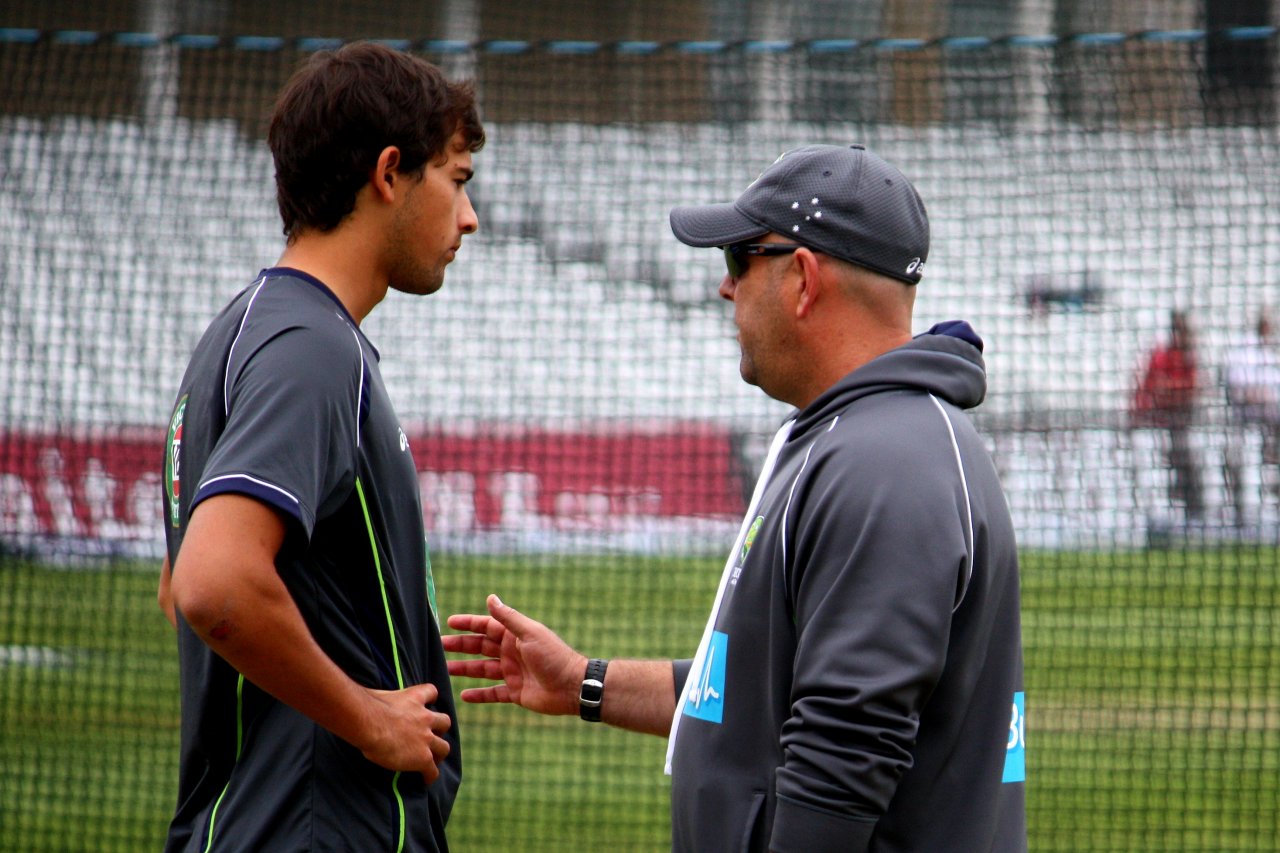
I kind of had an inkling it would go this way, watching the Australians warming up on the outfield before the start of play. Despite (or perhaps because of) the highlights of Day Four playing on the big screen behind them, Darren Lehmann made sure to keep his charges’ attention focused and their spirits high, organising a team huddle, taking the lead in a boisterous kickabout, larking about and playing the clown, but also having a quiet word with individual players, most notably Ashton Agar, who received the benefit of Boof’s wisdom during a break in the high jinks. They looked calm, relaxed, and united as a team, with genuine fondness and respect for their new coach. They did not look like a side who thought they were beaten.
Agar and Lehmann before start of play
Whatever Lehmann said to Agar, it worked, as, promoted to number eight, he continued where he’d left off after that fairy-tale knock of 98 that gave Australia a new hero to wake up to along with its Friday morning cornflakes. (That day, Agar’s emergence as a fully formed Test cricketer, was also the day of Ricky Ponting’s 169*, for Surrey at the Oval, in his last ever first class innings – one in, one out.)
Agar provided his partner at the other end, Brad Haddin, with able support in a 43-run, 24.4-over, partnership that soaked up the deliveries sent down by a bowling attack that had already spent a long day in the field and with an old ball that was doing nothing. Such was the epic nature of this match it was easy to view these two through the lens of heroic archetype, the stuff that myth is made of: battled-hardened veteran and youthful recruit, master and apprentice, Pat Garrett and Billy the Kid before that whole betrayal and manhunt thing.
Brad Haddin – so near and yet so far
The ability of the human body to withstand the rigours of extreme exertion while coupled with the will to win can produce greatness. That greatness manifested in Jimmy Anderson, steaming in from the Radcliffe Road end with a new ball that had all four remaining batsmen’s names written on it. Agar’s was the first wicket of the day to fall, Haddin’s the last – after a lunchbreak in which Australia were nine wickets down with 20 needed to win. Food may have been the last thing on the minds of the two teams during those 40 minutes. By 2:30 it was all over. Anderson, with 5-73, and ten wickets in the match, looked so exhausted at the Man of the Match presentation afterwards, he could barely string two words together.
It would take a book, and considerably more bandwidth, to describe all the extraordinary things that happened in this Test match. Along with Agar’s sparkling debut, Peter Siddle again proved he is the heart as well as the backbone of Australia’s attack with his fourth Ashes five-for on Day One as England collapsed after winning the toss. Ian Bell’s match- and career-defining innings of 109 came when England desperately needed it; a true-grit ton from a man often criticised for scoring soft runs when someone else has already done the hard graft. Last but not least, there was James Anderson’s unplayable delivery to Michael Clarke on the first day, and his wrecking-ball spell on the last.
Man on a mission – Anderson steams in
And then there was the decision review system, or more specifically, its shortcomings. In reality, it was more human error than failure of technology that caused the controversies, and while the referral by England that saw the back of Haddin and the end of the match was called controversial by some, in that instance it did exactly what it was supposed to – provide clear evidence, using the technology available, to overturn a wrong decision. True, there will be many “what-ifs” as a result of missed deflections, replays that showed evidence contrary to the decision given, and simple umpiring error; but what-ifs, of one variety or another, are what make all matches that linger long in the memory.
If Stuart Broad had walked after edging Ashton Agar to slip, England likely would have lost. If Agar, on 6, had been given out stumped England probably would have wrapped this up on Saturday.
Instead it came down to this: a morning session extended by half an hour, and then, on the restart, the simple equation of one wicket, twenty runs and a tail-end partnership that nearly made the difference.
Some of the previews for Trent Bridge were a little too dismissive of Australia’s appetite for this fight. I’m guessing the previews for Lord’s will make for slightly racier reading.
No need for Proust’s madeleine (or maybe that should be a Four’N Twenty meat pie) as I have this:
to remind me of this:
And it all starts again tomorrow. I hope I’m not tempting fate by mentioning these reminders of England’s triumph the last time these two sides met in the Test arena. The three weeks I spent in Australia, watching England retain the urn at Melbourne, and win the series at Sydney, were pretty much the best three weeks of my life.
Expectation regarding this go-round have grown markedly more realistic. England may be the better team in terms of results, ranking, and personnel, but Australia will be no pushover. Expect a few scares for England along the way. The fallout for whichever side loses will be brutal. But whether it’ll be Swann’s Way or Anderson’s swing that starts the ball rolling tomorrow – or if Cook, KP and co are subjected to a Pattinson peppering – the anticipation of new memories in the making is mouthwatering.
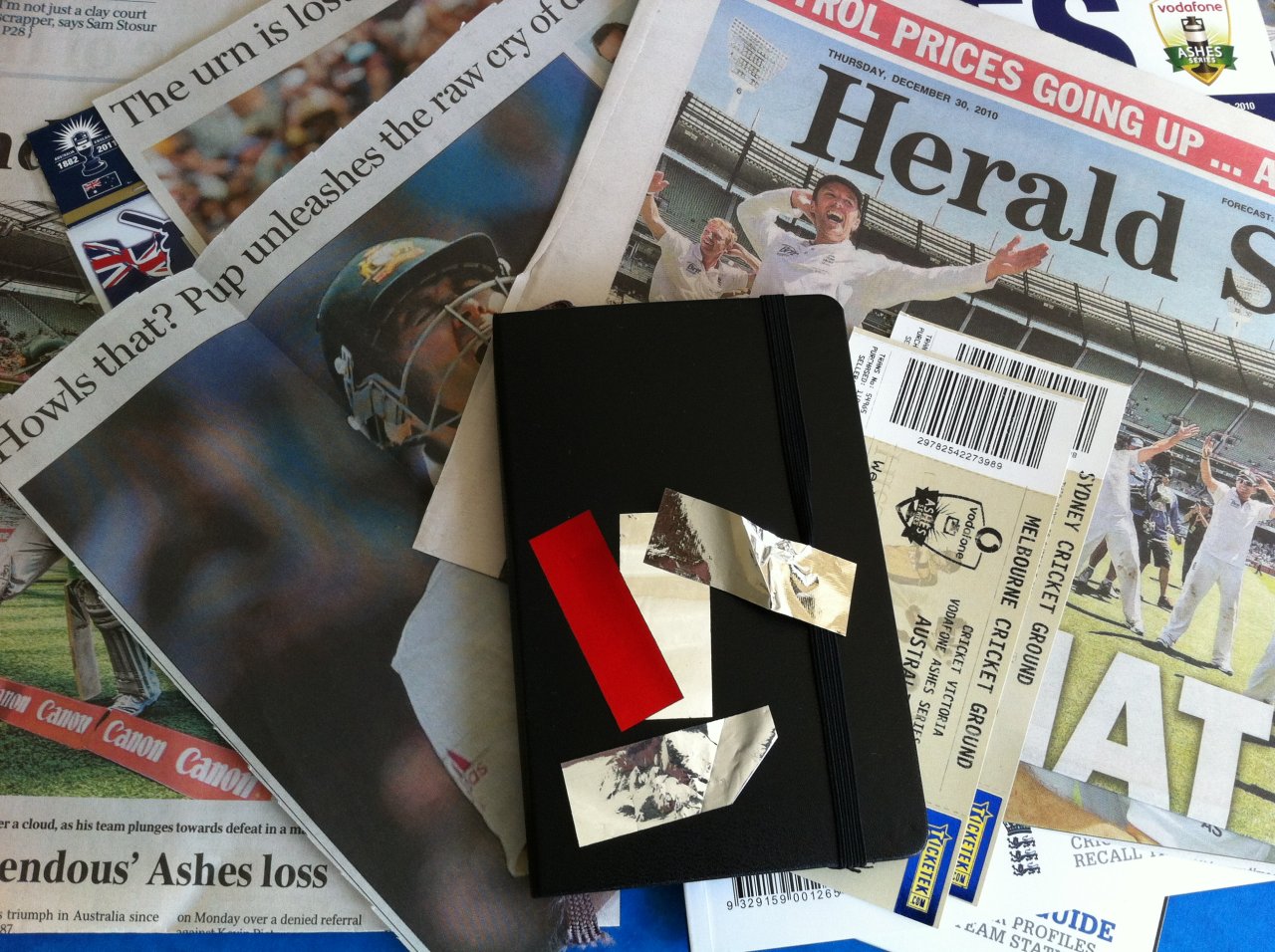
The pile of clippings I brought back with me from Oz, the magazines, match programmes, ticket stubs and Moleskine notebook filled with my fevered scribblings because I wanted to remember every second, are just the analogue tip of a media mountain that has grown exponentially over the last few years in terms of cricket coverage. Blogs, twitter, and websites, along with their august forebears television, radio, and the printed word, will be the avalanche that descends upon us all over the next few weeks, burying us with stats, analysis and opinion. Death by information overload, but what a way to go.
Tomorrow, it’ll all be distilled down to the simple reality of mano-a-mano, bat versus ball – no past, no future, just now. Formula 1 champion Jack Brabham once said: “When the green flag drops, the bullshit stops”. There’s another line I’ve always loved, spoken by Steve McQueen in the movie Le Mans, and which is applicable as much to the Ashes as to motorsport in terms of the distillation of expectation and moments that make history: “Racing is life… anything that happens before or after is just waiting”.
I have this image stuck in my head. Australia’s new coach, Darren Lehmann, fag in mouth, beer in one hand, reaches towards the switch that will flip into life the shambling monster that Australia has become.
A disparate hodgepodge of misbehaving parts, parts that have been bolted on where they don’t fit, and parts that have yet to show any sign of life whatsoever, it’ll take something along the lines of Dr Frankenstein to reanimate this mess.
Mickey Arthur’s more scientific approach didn’t work. Desperate times call for desperate measures and maybe, with “one of the worst Australian sides ever”, as they’ve been dubbed, a more maverick approach just might be the key. Or maybe Lehmann’s appointment was simply an act of desperation.
The timing, certainly, was curious: sixteen days before the start of the Ashes at Trent Bridge, Twitter was swamped with rumours that Mickey Arthur had been given his marching orders by a board that had finally run out of patience. To England fans, it must have seemed the cherry on the top of the schadenfreude gateau that had long begun taking shape in the overheated oven of Ashes expectation: the chewy base layer of a Test tanking in India, the creamy filling of Homeworkgate, with sprinkles of David Warner’s Twitter spray, dressing room splits, and a ridiculous incident involving Joe Root, a fake beard, and a Birmingham bar. It’s certainly been something to get your teeth into.
As half-baked rumour hardened into fact, it was difficult to know what to make of it all. Mickey Arthur was “a good man” who “tried his utmost”, in the words of Cricket Australia supremo James Sutherland in the first of three pressers. This was a disaster, said some pundits. No, actually, it was a good thing, said others – along with many of those who’d first proclaimed it a disaster but had now had time to think about it. The timing was bizarre, everyone agreed. This could either improve Australia’s chances, or it could destabilise them entirely.
But regardless of who’s wearing the chef’s hat, there’s only so much you can do with a batting lineup that puts one in mind of the contestant who always seems to turns up on Ready Steady Cook with a bar of chocolate, a tub of Philadelphia and a packet of digestive biscuits. “What can you make me with this?” Cheesecake. It is always bloody cheesecake. And the Australian recipe for this Aussie Ashes campaign looks anything but cordon bleu.
Perhaps Lehmann will be the man to bring something new to the mix. “My top three priorities are to win, win and win,” he said at the third of Tuesday’s press conferences. He didn’t waste much time in demonstrating that this is not simply bellicose bluster. Australia, declaring one run ahead in their first warmup match against Somerset at Taunton, signalled a new, aggressive intent: proactive rather than reactive, a readiness to take a risk to go for the win – which they achieved. This was aided by the one component of the squad in which there’s no doubt as to its quality. One statement Mickey Arthur made a couple of weeks back which prompted a fair amount of scoffing derision was his contention that “I honestly believe we can win the Ashes – we have the best all-round bowling attack in world cricket.” Perhaps that “all-round” should have been replaced with “seam”, and perhaps a “potentially” should have been slipped in there to not make it sound entirely ridiculous, but the way in which James Pattinson and Mitchell Starc shredded Somerset’s batting – from 310-4 to 320 all out – suggests that England retaining the urn may not be quite a straightforward formality.
True: the visitors only have one world-class batsman, a captain who must be the backbone of his side while he struggles with his own degenerative back condition. Where Michael Clarke fits into this whole saga will perhaps become clearer over time; he presented a united front with Arthur over Homeworkgate, but as a modern, ultra-professional sportsman, it’ll be interesting to see how his relationship with Lehmann – a throwback to more unreconstructed times when coaching manuals were considerably thinner and “work hard, play hard” just about covered it – develops. What has emerged from Lehmann’s coaching stints with Queensland, Deccan Chargers and Australia A is that he is a man who inspires intense loyalty but also respect – both of which seemed in short supply for Mickey Arthur at the end. While Australia’s precise lineup for the first Test is yet to be set in stone, it’s fair to assume that while the recipe may have its limitations, the heat in this kitchen will present no obstacle for the chef.
It’s interesting, too, that the underdogs are sounding considerably more bullish than the favourites. Lehmann talks about winning; Andy Flower is counselling caution. “We aren’t as good as some people are saying,” he said in an interview with the Daily Mail at the weekend. Alastair Cook, too, has refused to be drawn into anything resembling blustering prognostication, toeing the party line in maintaining that England are focussing on their own preparation and not what’s been happening in the Australia camp. It seemed somehow appropriate that he was at Wimbledon on Friday, watching Andy Murray’s unruffled progress to the fourth round while the Scot’s big-name rivals fall by the wayside through a combination of loss of form, injury, slippery courts and sheer bad luck. Australia may be embarking on a messy rebirth, but never underestimate the destructive power of the random and unexpected. God forbid, if Jimmy Anderson steps on a ball the morning of a crucial day in the field with the series in the balance, à la Glenn McGrath in 2005, it could be England’s hopes that are in need of resurrection. As we speak, Graeme Swann is off for an x-ray after being struck on the arm by Tymal Mills in England’s only warmup match at Chelmsford.
News has just come in, too, of confirmation that Shane Watson and Chris Rogers will open the batting for Australia when hostilities commence on July 10th.
The series is yet to begin, but the contest is already alive. The parts are coming together. Now let the sparks fly.