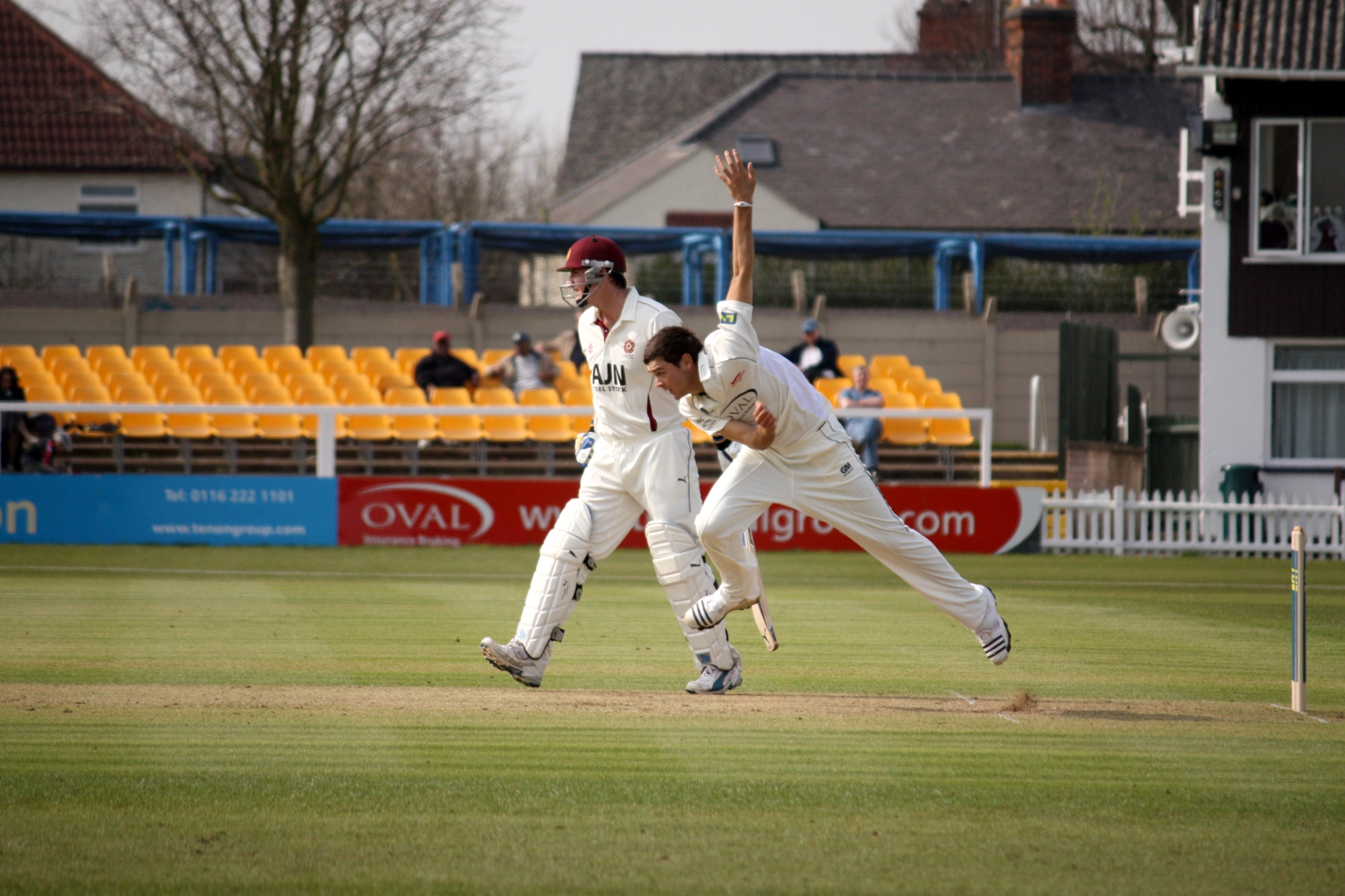
Archive for the ‘cricket’ Category
Wednesday, June 2nd, 2010
It’s weird, the transformation that occurs to my second home during a T20 match.
It’s like coming home after a day’s work to find you have all these distant relatives who you don’t know and who have turned up for a big party. The kids are jumping on the furniture and the adults have raided the drinks cabinet and are playing shit music on your stereo. Everyone is rowdy and talkative and having a good time. The only thing you can do is think “well, this kind of family reunion only happens once a year at most, so I may as well just go with it.” And while you’d not relish this kind of thing happening every day, and you know you’ll be glad to see the back of them, you realise that you are enjoying this while it lasts, and you are having fun.
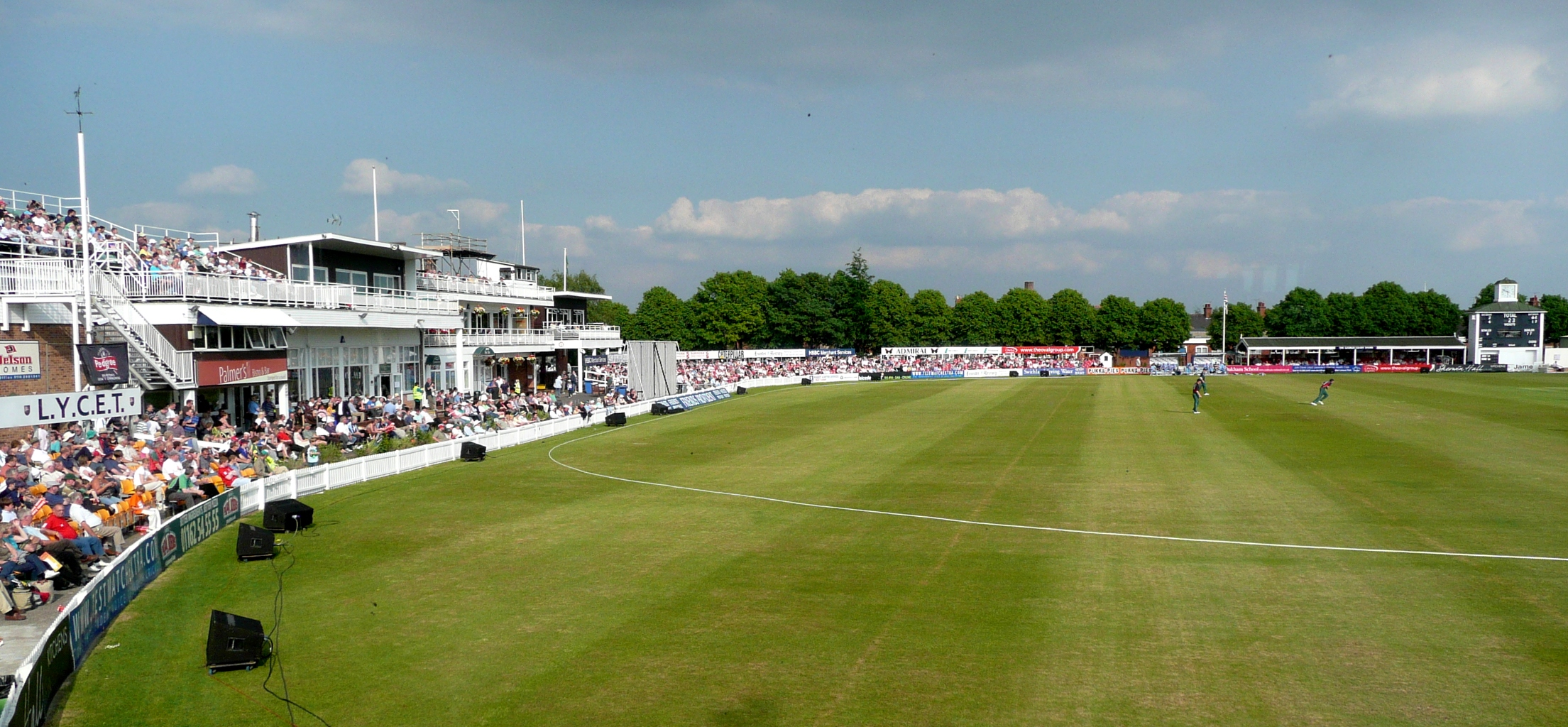
Today was the first T20 match of the season at Grace Road. Instead of just rocking up late morning/early afternoon, pushing through the turnstile after swiping my card and parking myself on a bench in front of the pavilion with a sigh of serene contentment, I had to negotiate security staff doing bag checks, stewards with walkie-talkies which squawked suddenly into life with loud bursts of static, kids chasing each other in front of the pavilion, long queues for the bar and the burger van and scantily clad young ladies handing out 4 and 6 cards. It was great. No matter what you may think of T20 – and I’m one of those who enjoy it in moderation – you know summer’s really here when they pull in the boundary, crank up the amplifiers and announce every new batsman’s arrival at the crease like they’re Russell Crowe in Gladiator.
 Good crowd in Leicestershire and Derbyshire are pretty well matched as sides. T20 is historically Leicestershire’s preferred format. We lost today, by 11 runs. As a Leicestershire member I’m used to this. My last post was written back in April and I couldn’t believe we’d started the season so well. Since then it’s been one long immersion in the bollock-shrivelling icebath of reality, with Leics on the receiving end of hammerings by Scotland, Sussex, Worcestershire, Gloucestershire and Glamorgan.
Still, hope springs eternal and all that, and there were some good things to take away from this match.
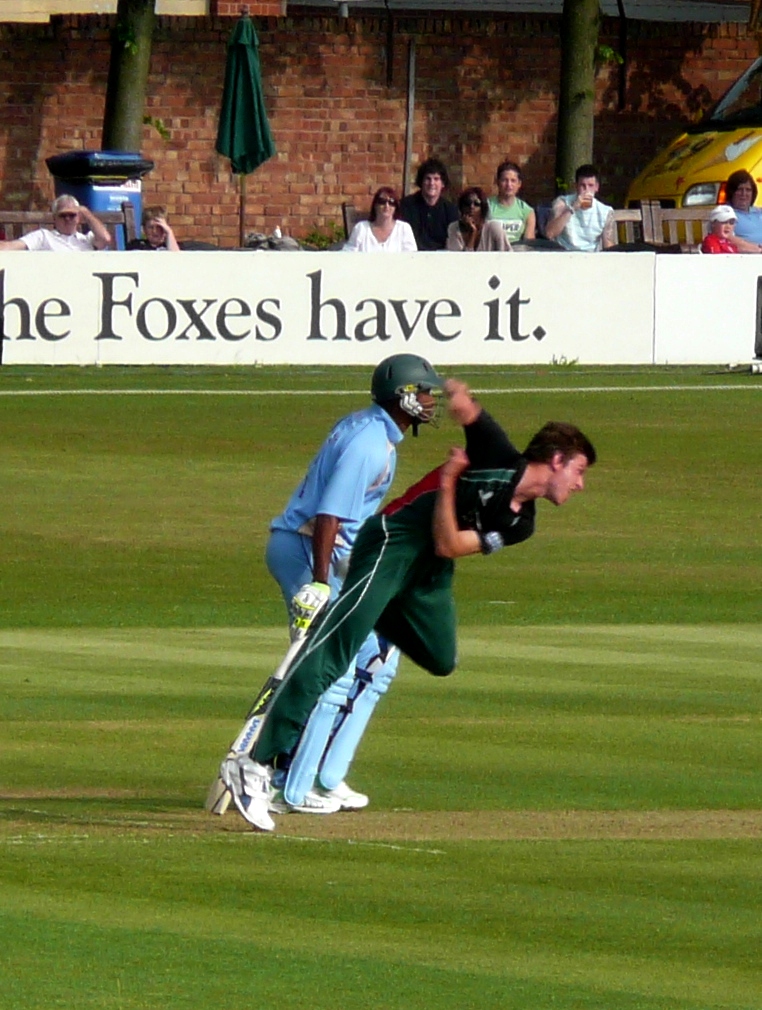
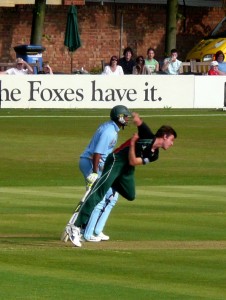 Harry Gurney Harry Gurney was our standout bowler – he’s another young talent who I hope we keep on our books for as long as possible – who stoppered up the runs in the early overs aided in fine fashion by Captain Hoggard at the other end. Andrew McDonald was magnificent with the bat, smiting 8 fours in a superb innings of 67. But aside from a useful partnership with Nixon, no one else managed to stay with him. Brad Hodge gave his wicket away and looked extremely rusty (and I’m being charitable here) with the ball; he and McDonald were particularly expensive.
Nevertheless we do have a fairly good T20 side and I’m hopeful we can get it together in time for our next encounter versus Northants at Wantage Road. Kipling’s imposters – triumph and disaster – I’m used now to meeting on equal terms, but more of the former and less of the latter for a change would be nice.
Tuesday, April 27th, 2010
Last week work-wise was a large steaming bowl of arse gravy. So the only antidote was to get myself down to Grace Road for the first Pro40, sorry, Clydesdale Bank 40 (jesus) match of the season, against Nottinghamshire.
And Leicestershire won, by crikey. Again. I make that 3 wins since Matthew Hoggard assumed the captaincy crown. Not wasting any time settling in to the job, is he?
Sunday was a rum old day as far as the weather went. I woke up at 5:30AM and it was hammering it down. Thankfully, the match wasn’t due to start till 1:45PM and for the rest of the day, bar the odd short shower (which fortunately didn’t interrupt play), we were spared by the weather gods, who, while making us aware of their presence, chose not to unleash the full extent of their wrath until after Leicestershire had wrapped up the victory and we’d made our way home.
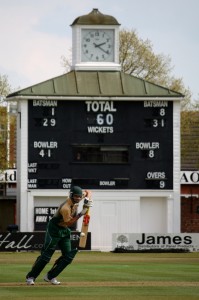 Welcome back, Jacques Jacques du Toit played a major part in giving Leics a total to defend, making 141 from 122 balls out of a total of 282-6, and Wayne White’s dream season continued with another personal milestone of a career-best 6-29.
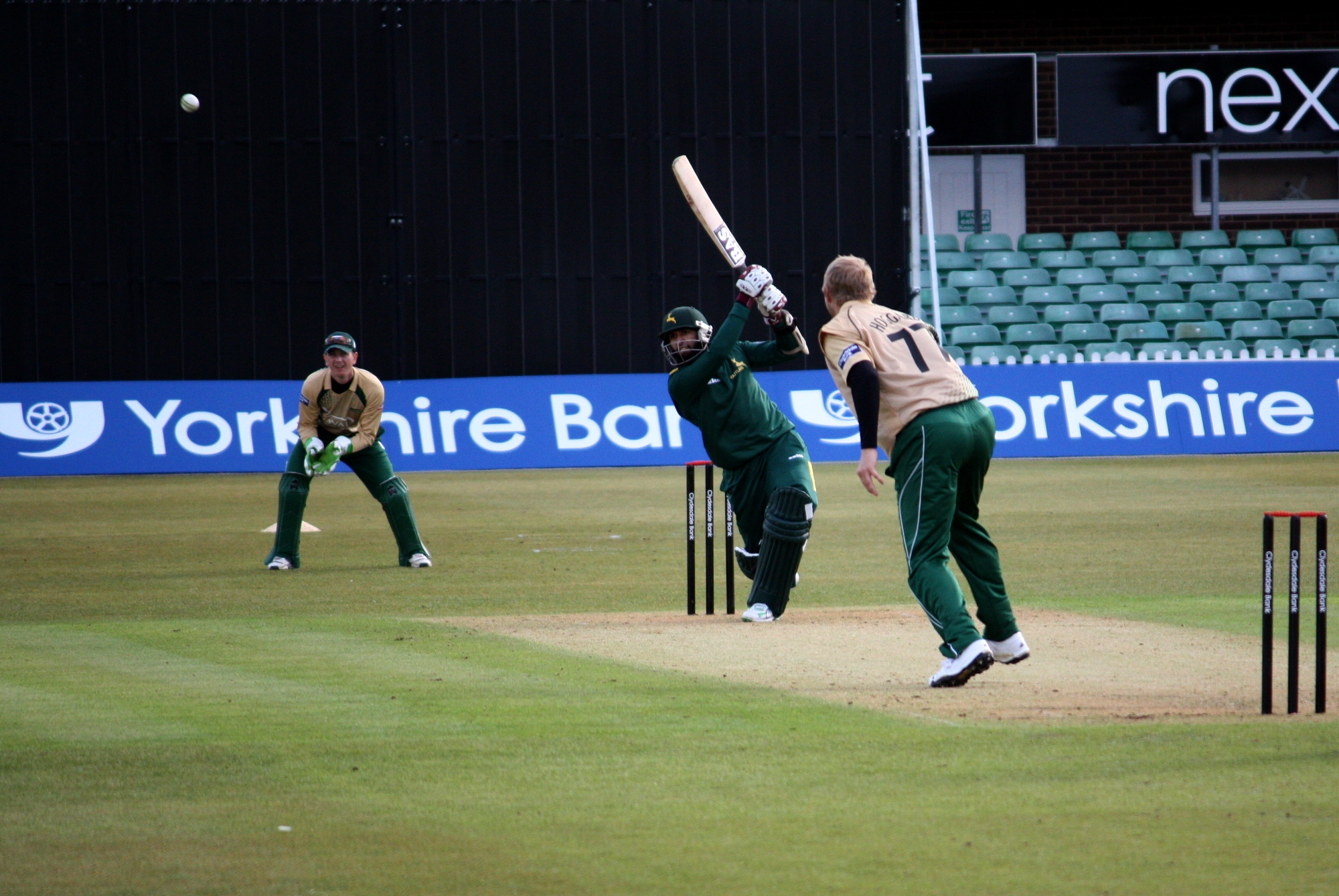
To be honest, seeing the way Amla and Hales opened Nottinghamshire’s innings, Leicestershire’s performance with the bat looked like it may have been found wanting. Amla’s placement and timing just made it all seem too easy – he really is a class act – and Alex Hales impressed with a confidence and maturity in aggressively going after the bowling. Hoggy, however, didn’t let the team’s morale falter, and after bringing on Claude Henderson the runs suddenly dried up and wickets started falling. Hoggard removed Hales and Wagh in the space of two overs, and Henderson and Harris chipped in with a wicket apiece with Josh Cobb turning his arm over to tie them down from the Pavilion end.
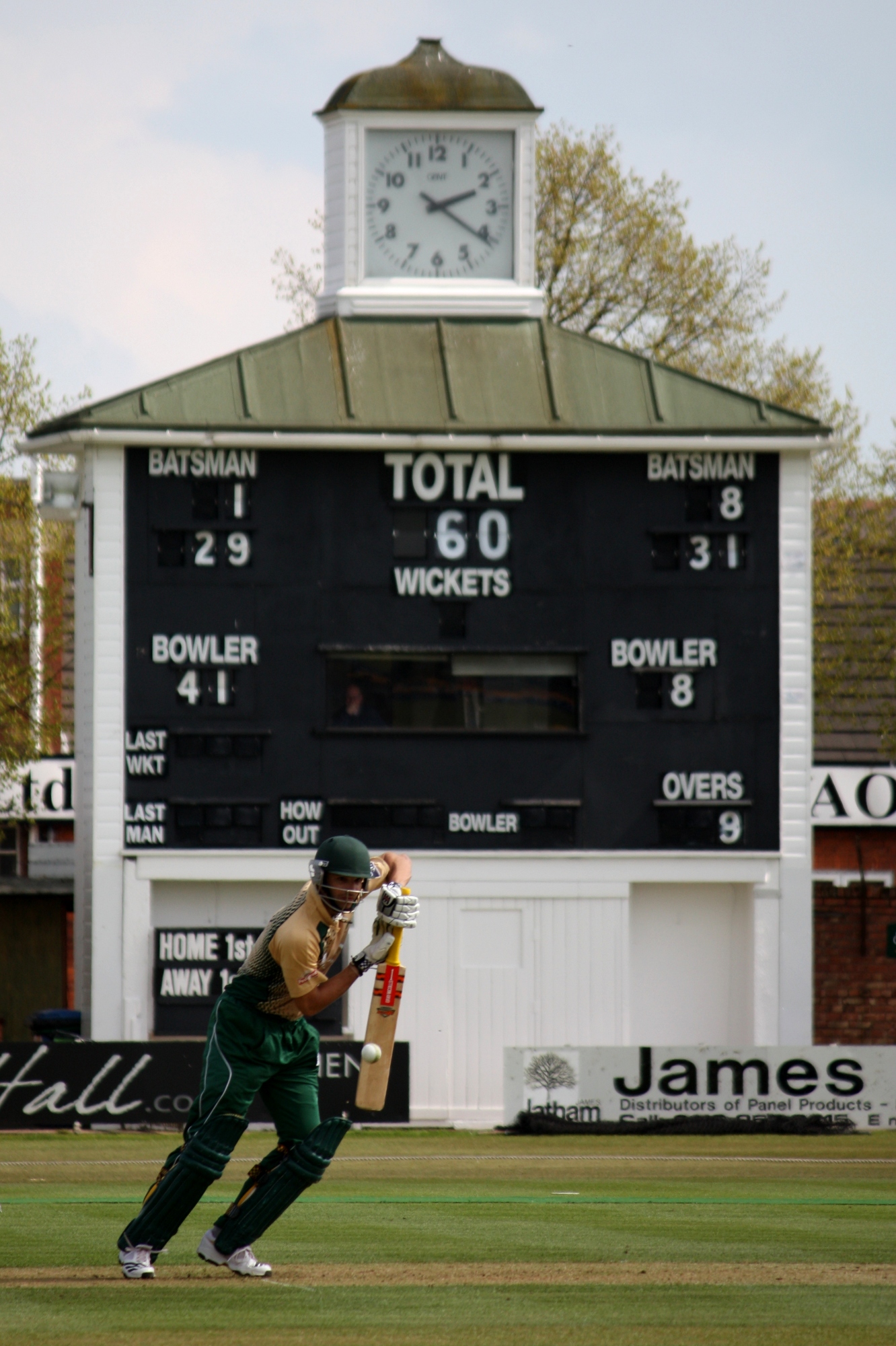
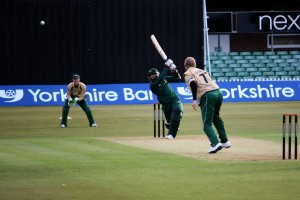 Hashim Amla - all class The match was arguably Chalky’s, though. Wayne White’s been having a barnstormer of a season so far; four of his wickets today came from 9 balls, and the atmosphere in the Meet, where I was sitting, was absolutely electric. A glowering bank of black rainclouds heaving in over Grace Road did nothing to dispel the tension, and many necks were cricked craning to make out the total required by Duckworth Lewis on the scoreboard, but victory for the Foxes arrived before the rain did, and boy, did it feel good.
It was a bit tough being a Leicestershire member last season. There was so much raw potential in the team, but the step from potential to performance a lot of the time seemed a leap too far. This year, the team seems to be playing with a sense of renewed purpose and enthusiasm, and I put this down, in large part, to the arrival of Matthew Hoggard.
Thanks, Hoggy. Long may it continue.
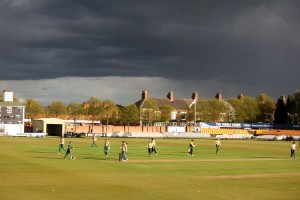 Cricketers of the Apocalypse - the rain clouds move in
Wednesday, April 14th, 2010
This weekend past was spent at Grace Road watching Leicestershire’s first game of the season against Northants.
The weather – on Saturday, anyway – was pleasant, cake was consumed, and Leicestershire won. Everything had been given a new lick of paint; most of the members had survived the winter. The guy I sat beside tried to consume his own body weight in picnic food in the shortest time possible. I bought a couple of books from the bookstall, collected my yearbook from the office and bought my ticket for the Lions game taking place in July.
 First cake of the season Everything had a pleasant “first day back at school” feeling about it, and despite a dire last season in which Leicestershire finished bottom of the second division, there was a cautious mood of optimism in the air. New season, new captain, new sense of purpose.
I missed James Taylor’s splendid innings of 88 on the first day, and the three wickets that fell during Leicestershire’s run-chase on the last, but I managed to watch everything else inbetween. Saturday was a great day for watching cricket. Leicestershire were already in a great position thanks to Taylor, ably assisted by gutsy knocks from Tom New, Matthew Boyce and Wayne White. AJ Harris chipped in with 20* in a useful partnership with White to take Leicestershire’s total to 395. It was a good total, but given the presence of Loye and Sales in the opposition batting lineup, I was fairly sure Northants would be able to match it.
Wrong. Harris dispensed of the openers early, and while Loye and Sales provided some dogged resistance – Loye in particular looked in good touch, and it was great to see him playing with something like his old confidence again – the decision of County’s new captain Hoggard to bowl Claude Henderson just before tea proved a masterstroke. By the end of the day he had taken 6-19 and Northants were teetering on 179-9. His was the standout performance, but I was most impressed with Nathan Buck who bowled his heart out on Saturday for no reward. Steaming in with consistent aggression he saw a couple of inside edges go for boundaries – when it’s your day, it’s your day, and today was not Bucky’s day.
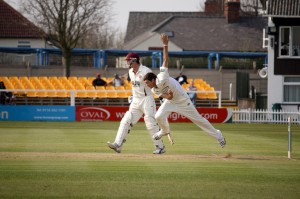 Bucky steams in Sunday was bloody cold compared to the blazing sunshine of Saturday. Hoggy sent Northants in again and they were bowled out for 269, leaving Leicestershire 65 to win. By stumps they had 14 of those 65 on the board with one wicket down, and on the last day went on to lose 3 more before Tom New and Josh Cobb saw them over the line. Harder work at the end than it should have been, but it was a win, and a good way to start the season.
Next up, Derby on Thursday, and the stomping ground of Chris Rogers who put Surrey to the sword at the Oval. Hoggard and his young team have momentum, and it should be a tasty encounter.
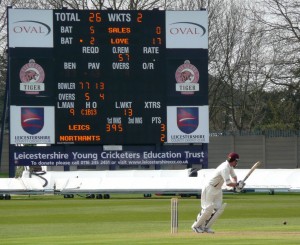 The return of Mal Loye
Tuesday, April 6th, 2010
It’s here:
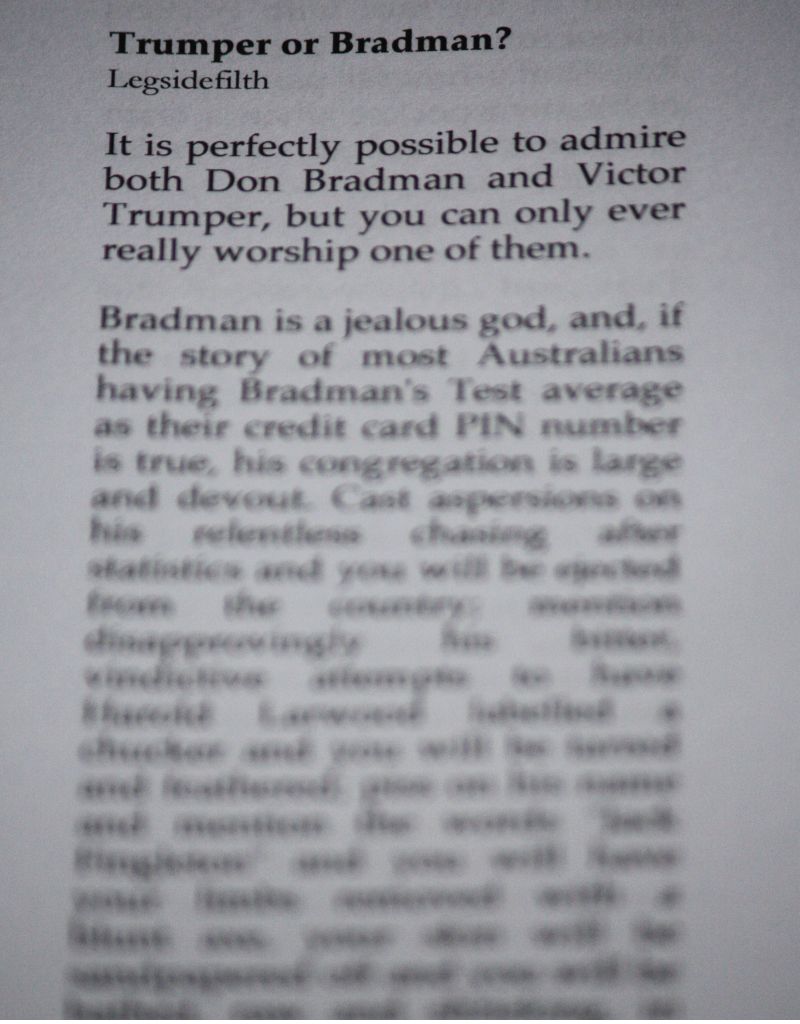
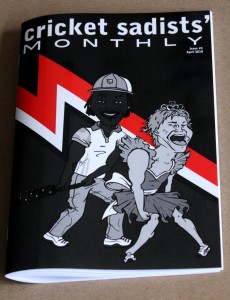 Cricket Sadists' Monthly April 2010 Cricket Sadists’ Monthly issue 1, available now. Featuring an article on Trumper and Bradman by yours truly.
 Trumper or Bradman?
Tuesday, March 30th, 2010
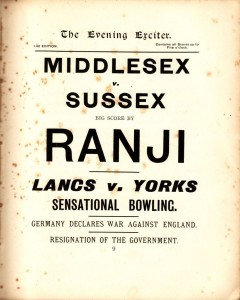
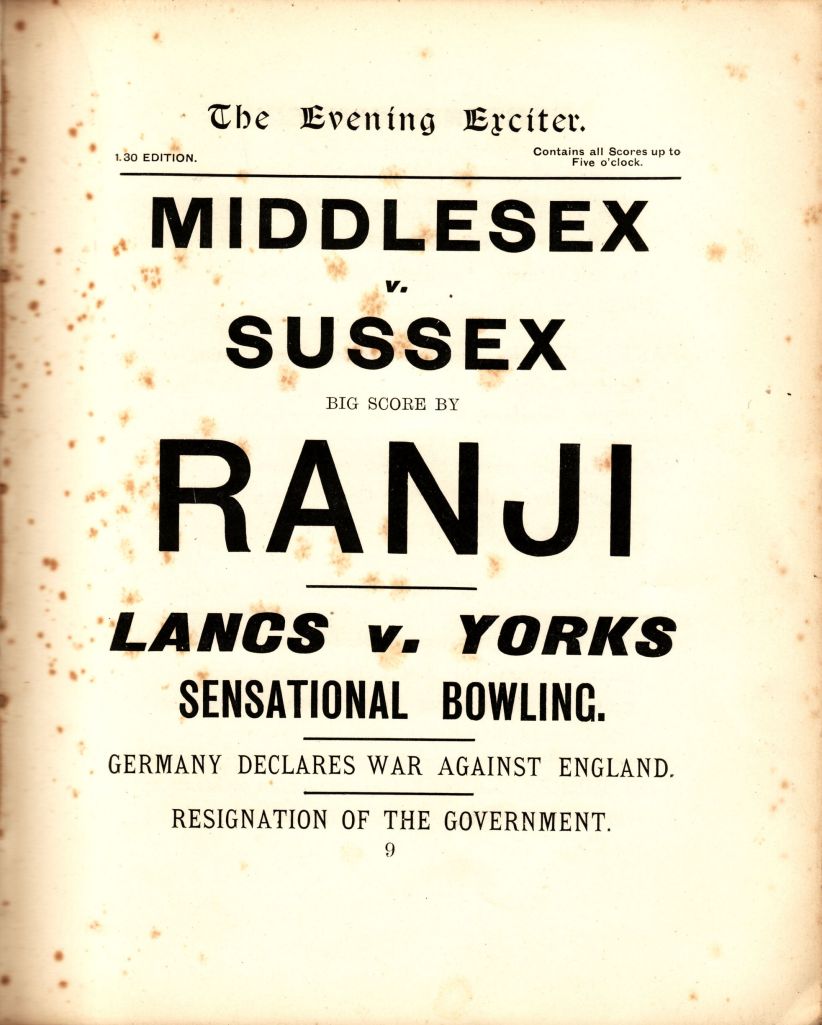
From Cricket on the Brain by “M.C.C.”, London, 1905.
Thursday, March 18th, 2010
On this day, 18th March, 1877, Clem Hill, arguably Australia’s greatest left-handed batsman, was born.
He was pretty badass. A child prodigy, he scored 360 for Prince Alfred College at the age of 16, and in his career as Test cricketer set records that stood until Don Bradman and Jack Hobbs broke them. One of the “Big Six” in the 1912 dispute with the Australian Board of Control, he flattened a selector with a vicious right hook (he also bowled right-handed) and almost defenestrated him. There’s not many cricketers who’ve almost succeeded in throwing a selector out of a third storey window, but there have been doubtless many since who wished they could have followed his example.
One of his finest innings was scored in between bouts of throwing up on the Adelaide wicket in 1908 after he’d been in bed with gastric flu for three days and England were well on their way to victory. Afterwards dubbed “Clem ‘Ill” by the press, he batted for 5 hours 19 minutes for 160. He pulled Australia from the mire of 180 for 7 with a record eighth wicket partnership of 243 with Queensland’s Roger Hartigan, and England were beaten by 245 runs.
He was the original “nervous 90s” specialist, being out for 99, 98 and 97 in consecutive Test innings. He is also the only Australian batsman to be dismissed twice in Tests for the unlucky score of 87.
As a batsman, he was rated second only to the great Victor Trumper. He relished taking on the quicks, and great England fast bowler Tom Richardson once said to him: “You make me feel I took up fast bowling for your benefit.” His hook was a statement of powerful attack and no little courage in those days before helmets and grills. Always eager to get off the mark, he would often take a single or more off the first ball he received – the Golden Age’s equivalent of Kevin Pietersen’s “Red Bull run”. Known for testing the nerves of wicketkeepers, about a third of his strokes were made outside his crease, and his method of recovering his ground was to swing the bat right over his shoulder upon completion of his stroke and smack it down on the crease with an alacrity that, in pre- third umpire slow-mo replay days, would have the umpire puzzled as to whether the bat had come down before the bails had been taken off.
No slouch in the field, in 1902 he ran 25 yards to take a spectacular diving catch on the Old Trafford boundary in a Test Australia won by 3 runs.
When not being wound up by selectors, Hill was happy-go-lucky with a sunny, even temper. He was an extremely popular Australian captain, even when his side were losing.
Even away from cricket his life was eventful. In 1913 burglars broke into his house, removed his safe while he was asleep and blew it up in the garden. They stole £500 pounds worth of jewellery, but didn’t take any of the bats he had been presented with, so they couldn’t have been cricket fans. In 1909, during a car ride with a couple of South Australian team mates, his car overturned with their chauffeur pinned underneath it. Clem, with help from his team mates, lifted the car off him. Three years prior to this a wagon had driven into the back of his horse-drawn trap while out for a drive with the missus.
He died on September 5th 1945 after being thrown from a tram. He didn’t have much luck with wheeled vehicles.
He is one of my favourite batsmen of all time.
Happy birthday, Clem Hill.
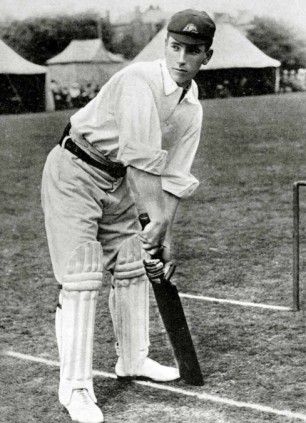 Clem at the crease
Tuesday, March 16th, 2010
Graeme Swann took 10 wickets. Alastair Cook brought up his maiden Test ton as England captain with a 6 on a wicket so flat you could have used it as an ironing board. England racked up runs gifted to them by Shakib Al Hasan’s blunder in choosing to bowl, and aided by a weak Bangladesh bowling attack Ian Bell scored 84 and 39 not out. England still took five days to win.
Alastair Cook didn’t enforce the follow-on despite being 303 runs ahead. Graeme Swann later attributed this to the tiredness of the bowlers who toiled all day on a wicket which admittedly offered nothing to the seamers. But if the rain which was forecast but never showed up had curtailed the match on Day 5 questions would surely have been asked. Swann bowled 78.3 overs, 36 per cent of the entire overs bowled by England in this Test match. Whether it was solely Cook’s decision, or whether Andy Flower had input as to whether or not pick James Tredwell and thus burden Swann with the lion’s share of the bowling, we will perhaps never know.
The fact is that over-cautious captaincy and short-sighted selection along with an opposition that refused to lie down and die quickly prolonged this Test match far longer than it should have been. This is not to denigrate Bangladesh: many have argued that they do not deserve Test status but they did improve throughout this match. Tamim Iqbal is a superb talent: he top-scored in Bangladesh’s 1st innings with 86, and his swashbuckling 125 in the first ODI was sublime. He is only 20 years old so there is still time to get that rashness out of his system that sometimes results in the needless squandering of his wicket. Junaid Siddique also scored a maiden century and Swann’s sendoff was perhaps a tad ungracious, but at the same time a reflection of just how big a thorn in England’s side Bangladesh’s resistance had become.
Mushfiqur Rahim’s been the player who has really impressed me, though. He kept the first innings going with a doughty 79 and a wild swipe dancing down the wicket to Graeme Swann got him out for 95 in the second. His 167-run partnership with Siddique kept England waiting for victory, with not a single wicket falling before lunch. He’s also only 5ft 4″ and his interview with Bob Willis at the end of Day 4 was worth its weight in gold for the mind-boggling discrepancy in scale. His work with the gloves is questionable but surely there’s a case to be made for pushing him up the order. Bangladesh will also be hoping Raqibul Hasan has a change of heart regarding his retirement from international cricket as they could do with him at number 4, with Tamim and Junaid opening and Mushfiqur at 3. Shahadat Hossain and Imrul Kayes should probably be dropped, with Shafiul Islam coming in for Shahadat, who’s been vociferous but toothless in this match.
James Tredwell must play in the next Test to provide support for Swann. Michael Carberry should be the one to make way as on a Dhaka deck that threatens to be flatter than this one it could be argued England already have enough batsmen and Carberry has not done enough to give the selectors a reason to retain him. This means that either Trott or Bell should open with Cook: Bell would be my preferred option as the last thing a brooding Jonathan Trott needs is to be shunted up and down the order. Broad looks tired and not altogether fit; they should rest him for the next Test and play Plunkett. The ECB says Paul Collingwood isn’t injured but he required a cortisone injection in his left shoulder and didn’t bowl, so he too remains a concern. Finn, aside from a nervy first spell, deserves more opportunities beyond this tour and it’ll be interesting to see him on a wicket with more bounce.
Cook’s captaincy hasn’t convinced me of anything other than competence displayed within the cautious cradle of a temporary appointment. His is a place-holder captaincy for a resting Strauss and his inexperience showed. Bangladesh, though, fought with honour and refused to be pushovers, and hopefully they can continue improving.
Swann was again superb, and Pietersen’s return to form encouraging. It would be nice, though, to see an England that didn’t make victory such hard work.
Thursday, March 11th, 2010
One is high maintenance, mired in controversy, conflict and off-field dramas that affect on-field performances. The other is Lara Bingle.
I’m talking about the Kolkata Knight Riders, my IPL “franchise” of choice, the team I nailed my colours to when the bloated behemoth that is the IPL bandwagon first rumbled into view in 2008.
Parallels between KKR and the Bingle imbroglio are inescapable. Back in 2006 Michael Clarke was introduced to Bingle on some reality TV show and she was probably wearing something tight and low-cut and Pup’s brain most likely fizzled, sparked, shut down and started playing that Wurlitzer organ music you hear at circuses. He fell, and fell hard. KKR has a take-me-to-bed line-up that bypasses the brain and goes straight for the groin region. Chris Gayle; Ricky Ponting; Brendon McCullum; Ishant Sharma when he still bowled at 145kph. As the eye-popping auction prices registered and the line-up fell into place it was like a tongue in the ear, hot breath on the neck and a whispered “Where the bloody hell are ya?” That team for the first match was my Fingal Spit; to say I was besotted was like a man wandering into the world’s greatest strip club and being told you can have this, you can have it all, even though, looking back now, the girls had serial killer eyes, the music playing was Combichrist’s “This Shit Will Fuck You Up” and the bouncers looked like they wanted to throw my still warm body out of a fast-moving vehicle.
Brendon McCullum’s orgy of hitting in that first match at Bangalore’s Chinnaswamy Stadium was the sweaty, frantic consummation of my absolute infatuation. A six-fuelled marathon of boundaries scored and deliveries dispatched to every part of the ground, it was T20’s equivalent of the greatest fuck you have ever had, or ever will have. It went on and on. Parts of me eventually started aching. It was so good it left me feeling like a spent, limp dishrag. It was so good I found myself thinking: “This could be it. This could be the one.”
It was always going to be tough for things to carry on this way. The first match had been enough to convince me to let the team move in, bringing its yapping Pomeranian and leaving its feminine hygiene products scattered around my bathroom. It took a while for me to realise, as KKR’s star fizzled and dimmed, as the team stumbled from one inept defeat to another, that there were things about my chosen amour that could, let us say, prove to be matters for concern and that may even, in time, jeopardize our relationship. But, like the vacuous reality behind the facade that emerges when Bingle opens her mouth in interviews, it was easy to ignore that all was not a bed of roses. Besides, we looked smoking hot together: everyone knew KKR was packed brimful of superstars; they were the “it” team, and surely it could only be a matter of time before success was theirs again. Wrong: they never even made the semis.
2009 was when the shit really hit the fan. It was the year of meltdowns, player mutinies, Fake IPL Player and Sourav Ganguly throwing hissy fits over anything that offended his sense of self-importance. The team changed captains more times than Bingle changes her managers. Fake IPL Player was, of course, the Brendon Fevola shower photo: a muck-raking deluge of truths, half truths and innuendo that hinted at just enough unpleasant goings-on to give me grave misgivings about our future together. I, like Michael Clarke, began to feel “lost and confused”. I was now beginning to realize that my team was beautiful, bat-shit crazy and baggage-laden. And maybe even, in the cold light of day, actually not that hot.
As if things couldn’t get even more ridiculous, on the eve of IPL 3 I learn that like, Bingle with her shady Sydney connections, KKR have signed a new shirt sponsor which happens to be a company whose owners are implicated in a murder investigation. And the worst thing is the new colours are gold and purple. Purple. For christ’s sake, no one looks good in purple.
But, though I should know better, I am besotted still. Dav Whatmore has been brought in as coach to replace John Buchanan who along with all his cod-psychological bullshit has been given the heave-ho. Wasim Akram – WASIM FUCKING AKRAM – is bowling coach, sorry, “mentor”. Chris Gayle will be available for most of the tournament, Owais Shah has been brought in from Delhi to bolster the batting and Brendon McCullum and Shane Bond will no doubt fly out on the first flights available after fulfilling their international commitments.
It is memories of McCullum’s 73-ball 158* in that match at Bangalore that keeps me coming back for more. Thinking about it even now gives me sweaty palms and reaches parts of me other IPL teams cannot.
So, I am not yet ready to call in the removal vans, drop-kick the Pomeranian off the balcony or demand the return of my 4.7-carat loyalty to this team. The future will undoubtedly hold more scandals, more meltdowns, more player revolts; but all I have to do is imagine McCullum’s incendiary innings and all reason and sense of reality goes out the window, my brain fizzles, sparks and shuts down and starts playing that Wurlitzer organ music you hear at circuses.
Maybe it really is love, after all.
Monday, November 16th, 2009
When his side is reeling from the loss of early wickets and Rahul Dravid steps into the breach, watching him is something akin to the comforting thunk of the central locking on an expensive saloon as you’re driving through a particularly dodgy part of town. Danger is averted; the sense of panic passes; the blood pressure settles down because you know things will be okay.
There hasn’t been that reassurance from Dravid for a while in international cricket. He’s looked uneasy at the crease; a man struggling with the weight of all those runs already scored for India and with the expectation of their continuation, and while young guns like Virat Kohli and Suresh Raina have been snapping at his heels you get the feeling it’s not been the age so much as the mileage. Unceremoniously dumped from the ODI side in October, his domestic form recently has been superb, averaging 77 for Karnataka in the Ranji Trophy, so perhaps it was only ever going to be a matter of time before he gave notice to these pretenders that the Wall was not for shifting.
And so it was today. He finished Day One of this first Test against Sri Lanka on 177 not out, out of a total of 385. Marshalling India from a potentially-catastrophic 32-4, his innings comprised 26 free-flowing fours and a six slapped imperiously off Rangana Herath over long-on. He shared in two 100-partnerships with Yuvraj Singh and MS Dhoni, and reached the milestone of 11000 Test runs, passing Steve Waugh in the process. Cuts, drives, pulls, flicks off the pad; this Dravid was a re-tuned, fuel-injected version of the model that scored runs in New Zealand back in March but never looked entirely convincing. It’s been a long time since we’ve seen him play with such confidence and exuberance; his timing was perfect, his placement impeccable. This was not the immovable object so much as the unstoppable force.
“I’ve been playing for a long time. I’ve been around the scene for a long time,” he said afterwards. “It’s nice. I guess it is something about my longevity. I’ve been able to be consistent over pretty decent periods of time which has helped me stack up these numbers. It’s a nice thing.”
Yes. Yes it is. Even if he gets out first ball tomorrow morning it doesn’t matter, because this has been one of the great Test innings.
Saturday, November 14th, 2009
On the wall above my television hangs a photograph of Victor Trumper, crown prince of cricket’s Golden Age and arguably the greatest batsman in the history of the game. He’s playing a yorker to the square-leg boundary.
Think about that for a minute. Fast bowlers would send a toe-crushing missile down the line of leg stump and go up for lbw only to find that Trumper had lifted his foot, got bat on ball and sent it racing away to the boundary. Orthodoxy didn’t matter that much to the great man when circumstances demanded it. “Cricket,” wrote Monty Noble, “at that time was languishing under the spell of orthodoxy and passive resistance… Victor’s wonderful demonstrations shocked old ideas and brought light out of semi-darkness. With his coming the old order passed for ever.”
Trumper was ahead of his time and there will never be another like him. Sadly though, it seems orthodoxy and passive resistance still have a place in modern cricket, and nowhere has this been more infuriatingly obvious than in the England team’s approach to the limited overs formats. “One has to be very sure of oneself to go against the ordinary view of things; and if one isn’t, perhaps it’s better not to run any risks, but just to walk along the same secure old road as the common herd. It’s not exhilarating, it’s not brave, and it’s rather dull; but it’s eminently safe.” Somerset Maugham never played cricket for England, but it wouldn’t be too much of a stretch to imagine this gem from Mrs Craddock included in a current England batting manual.
So imagine my surprise when Eoin Morgan’s flick back over the head of the umpire for six in last night’s first Pro20 game against South Africa wasn’t greeted with angry villagers brandishing flaming torches and pitchforks. Advancing down the pitch to the quicks; a towering straight six; the ball deposited on top of a three-storey building; reverse sweeps for 4… who the hell is this heretic and how did he get into the England team? 85 off 45 balls, 188.88 strike rate: look, just do yourself a favour and look at the scorecard, and marvel.
The match fizzled out when the deluge set in and England won by a D/L-assisted 1 run, but it’s the new fearlessness of the batting that’s the real story here. Of course England have been here before and with another buccaneering batsman of Irish heritage no less, in the form of Mal Loye in the Commonwealth Bank series of 2006-7. Loye was only ever a stand-in for the injured Michael Vaughan, a fact made plain to him by the then Chairman of Selectors David Graveney when he was subsequently left out of the World Cup squad: shoddy treatment meted out to a man who many argued should have been in the England squad years before on the back of scintillating form for Northants.
Loye’s brief appearance on the international stage was memorable for his utter disdain for orthodoxy in attacking the bowling. That’s not to say he couldn’t play outstanding orthodox cricket shots; those big booming drives were as satisfying in their way as him getting down on one knee and slog-sweeping Brett Lee (and Glenn McGrath, Shane Bond, Mitchell Johnson and Nathan Bracken) into the stands for six. Because it’s for those slog-sweeps England fans will always remember him: even when his foot slipped in the 10th ODI and a thunderbolt from McGrath hit him in the mouth necessitating the need for a visit to the hospital and three stitches, he was back at it again in the 2nd final, carting McGrath over the square-leg boundary rope from a ball pitched wide of off-stump.
The trouble is that one always felt that Loye’s idiosyncratic (but effective) approach was considered a little outré by those that run English cricket. One gets the feeling they’d never seen the like of a batsman rampaging down the wicket to a fast bowler and risking teeth and limb to throw him off his length, and they found it all rather overly flamboyant with a bit too much risk involved. It’s as if the board of selectors feared this orgy of slog-sweeping might usher in an apocalypse of flicks, scoops and a maelstrom of fast-paced hitting, and there was something a bit, well, not quite English about all of this.
Eoin Morgan isn’t Mal Loye – there’s less of the eccentrically-intense maverick about him – and he’s certainly not Victor Trumper, but by god it did the heart good to see him taking the attack to South Africa. And yes, as in the case of Loye, his offence-before-defence approach may not always come off. There will be times he’ll get out cheaply to a shot falling the wrong side of the line separating genius from rash impulsiveness. But this type of batting should be encouraged – hell, it should be celebrated, even in the event of failure – and not stifled. Morgan, showing a commendably level head, isn’t taking anything for granted as far his place in the team goes but his performance last night suggests he will be there for some time, and that’s as it should be.
After plumbing the depths of a post-Ashes 6-1 ODI drubbing at the hands of Australia, England showed signs of their brave new intent in the Champions Trophy with victories over Sri Lanka and South Africa, two of the finest limited overs sides in world cricket. When asked where this new intent – some might say recklessness – had come from, Andrew Strauss responded: “I think one of the things we’ve done since coming here is to go out and show people what we can do and not die wondering. That’s come out in both the games we’ve played.”
When I look at my photo of Trumper, that lifted left foot and bat jammed down sending the ball on its way for four, I wonder sometimes what he would have thought of this limited overs malarkey, and Twenty20 in particular. I’m thinking his eyes would have lit up at the batsman-friendly wickets, his blood would have fired at the thought of imposing himself on the bowling, and the challenge of hitting as many sixes into the crowd as possible would have been like the bray of a trumpet to a battle-charger. Perhaps, on the evidence of their showing in the Champions Trophy, and the Pro20 last night, England are taking a leaf out of Trumper’s book at last and exploring the possibilities that they’ve never before seriously considered. What this heralds for a team currently languishing 6th in the ODI rankings and 9th in the Twenty20 wins-percentage table is anyone’s guess, but at least they – and we – won’t die wondering.
|
|